
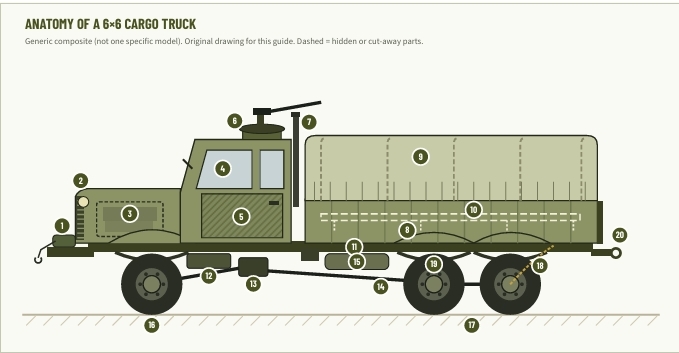
A military truck is just a commercial truck on Steroids: more driven wheels, more ground clearance, simpler controls, and parts a soldier can fix in a field. Below is a simple guide to what each component does, helping you accurately identify and name parts within a scene.
- Winch- A powered drum and steel cable on the front bumper, driven off the engine. A truck can winch itself, or another vehicle, out of mud. The M35A2's optional front winch was rated at 10,000 lb. of pull.
- Radiator & Grille- Keeps engine cool. Military grilles are heavy steel bars, often flanked by small blackout lights.
- Engine- Gasoline in WWII. Then multifuel (M35/M54 era: diesel, jet fuel or, with oil added, gasoline), then turbo-diesel. Modern trucks run on military JP-8/diesel.
- Cab-The crew space: driver plus co-driver or vehicle commander. WWII trucks had open or closed cabs. Modern ones have armored, air-conditioned capsules.
- Armor kit- Bolt-on steel or composite panels. In Iraq these started as improvised "hillbilly armor" and became factory kits. HEMTTs are built "A-kit" (armor-ready) so a "B-kit" can be added.
- Gun ring/turret- A circular track over the co-driver's seat for a machine gun. One in four WWII CCKW cabs had one. Modern trucks may carry a gunner's turret or a remote weapon station.
- Exhaust stack- A vertical pipe behind the cab. Diesel and multifuel M54s had a vertical stack on the right fender, gas models a down- swept pipe.
- Cargo bed- The flatbed box. An M35's standard bed is 8ft wide by 12ft long, with a drop tailgate.
- Bows & tarp- Removable steel hoops (bows) hold up a canvas cover (tarp, tilt) Rolled up, they let troops see out. When placed down they keep out the rain and dust.
- Troop seats- Fold-down wooden or metal benches along the bed sides, with troops facing inward. Britain built a dedicated troop-carrier QL, the QLT.
- Chassis/frame- Two long steel rails running the length of the truck: the backbone that everything bolts to. Many MRAPs instead use a monocoque V-hull, where the armored body is itself the structure.
- Transmission- The gearbox. WWII and Cold War trucks had 4-or-5- speed manuals. Modern trucks use Allison automatics.
- Transfer case- A second gearbox that splits power between front and rear axles and adds a low range for crawling or heavy pulls. The CCKW combined a 5-speed with a 2-range transfer case.
- Driveshafts- Spinning steel tubes carrying power from the transfer case to each driven axle.
- Fuel tank- Usually slung under the body. An M35 holds 50 U.S. gallons, good for roughly 400-500 miles.
- Axles & differentials-Each driven axle has a differential (the "pumpkin") that lets left and right wheels turn at different speeds in a curve.
- Tandem rear axles(6x6)- Two driven rear axles share the load and add grip. "6x6" means six-wheel positions, all powered. Dual tires count as one position.
- Central tire inflation (CTIS)- Lets the driver let air out of, or pump air into, the tires from the cab. Low pressure spreads the footprint for sand, mud and snow. High pressure suits the highway.
- Suspension- Leaf springs on beam axles on classic trucks. newer trucks such as the M-ATV have independent suspension (Oshkosh TAK-4) for rough ground.
- Tailgate & pintle hitch- The rear hook that tows a trailer, water tank, or artillery piece.
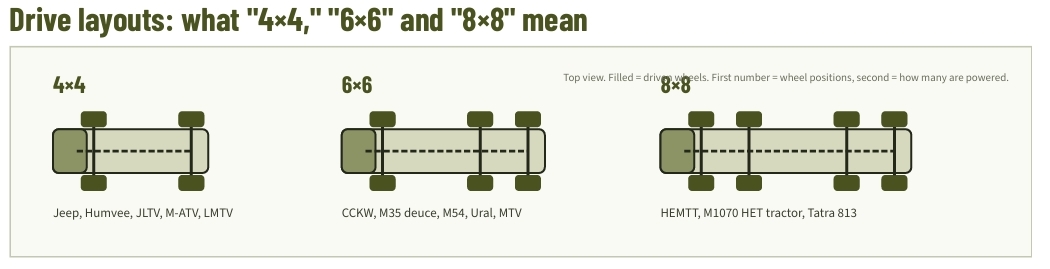
The first number is wheel positions (axle ends) and the second is how many are driven. A "6x4" has three axles with only the rear two driven (Studebaker built 5-ton 6x4s alongside its 6x6s). More driven axles means more grip and load.
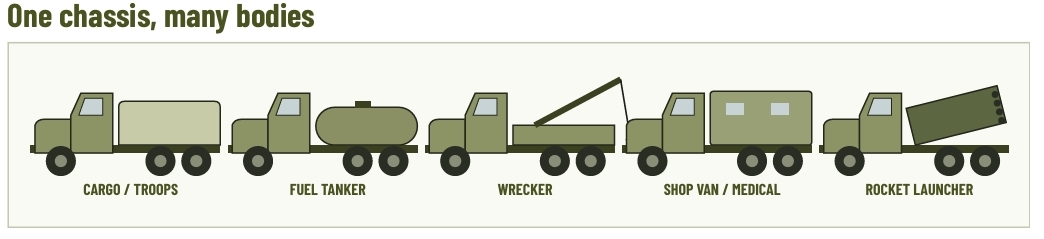
Armies save money and spare parts by building many bodies on one basic ruck. The HEMTT family alone includes a cargo truck (M977), a fuel tanker (M978), a tractor, a wrecker (M984), a load-handling truck (M1120), a firefighting truck, a water tender and even the THAAD missile launcher. Britain's Bedford QL served as a troop carrier, gun tractor, tanker, signals truck and fire engine.
Fuel tankers: Fuel ("POL," for petroleum, oil and lubricants) is the heaviest daily need of a mechanized army. A 2021 analysis notes that armored vehicles burn fuel even idling, which is why the U.S. Army plans fuel in "days of supply," not range. Tankers are prized targets. Ukraine-war loss counts for the Ural-4320 out tankers separately.
Water trucks: Water tenders such as the HEMTT M1158 haul drinking and cooking water to bases in desert and summer heat.
Wreckers: Recovery trucks with a boom and winches tow broken or blown-up vehicles back for repair. In the HEMTT family the wrecker is the M984. In 1944 a Red Ball driver whose truck broke down had to pull out of the convoy, try to fix it and, failing that, wait for ordnance repair crews.
Load-handling systems: The Palletized Load System (PLS, in service from 1993) uses a hydraulic hook arm to pull a whole flatrack of ammunition or a container onto the truck and drop it off with no forklift.
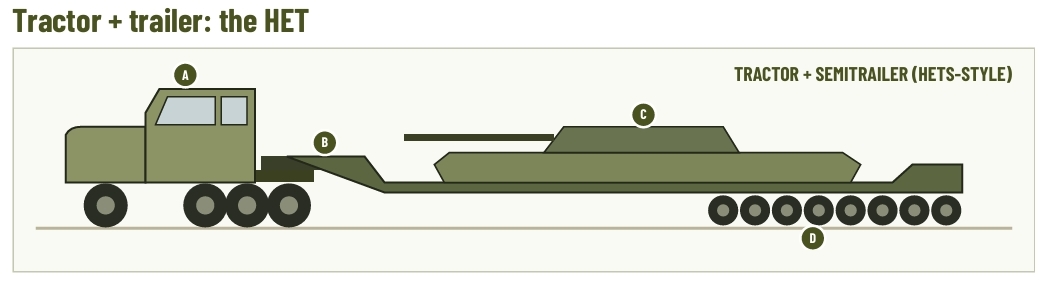
Carrying tanks on trucks saves their tracks, engines and fuel for the fight. In World War II the same job fell to the M19 tank transporter: a Diamond T 980 (M20) truck pulling a 12-wheel M9 trailer, with more than 5,000 built.
- Tractor Cab - (the M1070 seats two crew plus four mor, enough to carry the tank crew along).
- Fifth-wheel Coupling.
- Payload- the Heavy Equipment Transporter System exists mainly to carry the M1 Abrams tank, and it also moves armored personnel carriers, self-propelled guns and bulldozers.
- Multi-axle lowboy semitrailer (M1000) that spreads the weight.
For 80 years, 100% employee-owned Memphis Equipment Company (MECO) has specialized in U.S. military vehicles, custom builds, and hard-to-find parts. With millions of parts shipped globally since 1946, our team is ready to help you get the job done. Explore our full inventory on our website today.