
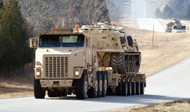
When we think of military history, we often focus on the front lines. But armies don't move without supplies. For Veterans Day, we are looking at the lethal reality faced by logistics troops through history—proving that the supply route is often the most dangerous front line of all.
1944: The Red Ball Express
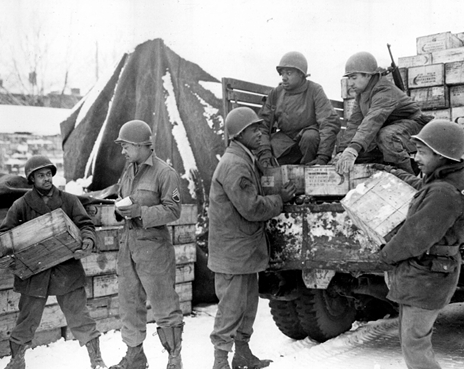
Following D-Day, Allied forces raced across France so quickly they threatened to outrun their own supply lines. The solution was the Red Ball Express, a massive convoy system fueled by sheer exhaustion and determination.
- The Rules: Keep 60 yards between trucks, cap speeds at 25 mph, and strictly no passing.
- The Reality: Young drivers—mostly Black soldiers in a segregated military eager to prove their combat readiness—smashed governors to race over 60 mph in pitch-black conditions.
- The Cost: Drivers frequently spent 36 straight hours at the wheel without sleep, splashing water on their faces to stay awake and deliver the fuel that kept Patton's tanks moving.
Vietnam: The Birth of the Gun Truck
In Vietnam, the 8th Transportation Group faced a brutal gauntlet running Route 19 through "Ambush Alley". To survive devastating Viet Cong ambushes, transportation units took matters into their own hands.
- Improvised Armor: Crews pulled trucks out of cargo duty, lined them with steel plating scavenged from scrapyards, and heavily armed them with .50-caliber machine guns and miniguns.
- Counterintuitive Tactics: Instead of fleeing an ambush, these "Gun Trucks" were ordered to drive directly into the kill zone to smother the attackers with overwhelming firepower.
- The Legacy: Legendary trucks like the "Eve of Destruction" became symbols of crew ingenuity, earning crewmen medals of honor and protecting thousands of lives.
Iraq & Afghanistan: The IED Menace
By the 2000s, the supply route officially became the primary front line. In April 2004, militia ambushes near Convoy Support Center Scania targeted the vital supply lines entering the Sunni Triangle, killing civilian contractors and military drivers alike.
- The Enemy: Improvised Explosive Devices (IEDs) became the leading threat, causing roughly 75% of U.S. combat casualties by 2008.
- The Pivot: Troops initially welded improvised "Hunter boxes" onto 5-ton trucks. This desperation ultimately triggered the MRAP (Mine-Resistant Ambush Protected) program, rushing over 13,000 blast-resistant vehicles to the field to shield transport units.
2022–2025: The Drone Era
Modern warfare in Ukraine has rewritten the convoy playbook, showing that massive, stalled logistics columns—like Russia's infamous 64 km Kyiv convoy in 2022—are sitting ducks.
- The Widened Kill Zone: First-Person View (FPV) drones have expanded the highway danger zone to a massive 10 km behind the front lines, accounting for up to 70% of injuries at some medical facilities.
- Cat and Mouse: Driving a standard logistics vehicle has become virtually suicidal. Supply troops now navigate highway "tunnels" made of anti-drone netting while enemy drone operators actively wait to ambush them at the exits.
Honor the Drivers
This Veterans Day, remember the soldiers who didn't just fight for the hill—they fought to get the fuel, food, and ammunition up the hill. As an old wartime quote accurately puts it: "They got the supplies to the front and if necessary, they died with their hands on their wheels."
At Memphis Equipment Company, we have dedicated ourselves to reconditioning and supplying parts for the nation's most rugged all-wheel-drive military trucks since 1946. Seeing the harrowing history of tactical logistics laid out in this blog reminds us exactly why we do what we do.